This is the third target the project has screened, following the pivot to trypanothione reductase. CYP51 was picked partly because I already know, roughly, what a correct answer should look like — which makes it a real test of whether the pipeline is doing what I think it's doing.
Step 1: Why this target is a built-in test
CYP51 (sterol 14α-demethylase) performs one step of ergosterol biosynthesis — the parasite's version of building its own cell membrane. Block it and the membrane fails, a completely different "kill it" mechanism from PTR1's folate salvage or TR's redox defense. The reason this target doubles as a pipeline check: azole antifungals (fluconazole, itraconazole, ketoconazole, posaconazole, voriconazole) are well-documented CYP51 inhibitors with real published antileishmanial activity, and they're also dirt-cheap generics — fluconazole runs a few dollars a month. If the receptor prep and pocket detection are working correctly, the known azoles should land somewhere near the top of the results. If they don't show up at all, that's a real warning sign about the setup, not just an uninteresting result.
Step 2: Receptor prep
PDB 3L4D, CYP51 from Leishmania infantum, solved with fluconazole already sitting in the pocket — the same advantage 1E92's bound dihydrobiopterin gave PTR1: the real ligand pose defines the box with no guesswork. Unlike TR, CYP51 (like all cytochrome P450 enzymes) is monomeric, so I only kept chain A. The heme cofactor stayed in (the pocket only has the right shape and chemistry with it present), fluconazole and waters were stripped out.
Step 3: Finding the pocket
fpocket's top hit on chain A was druggability 0.993 — the sharpest, most well-defined pocket of all three targets prepped so far — sitting directly above the heme iron, exactly where the substrate channel should be. Docking box centered on (33.192, −24.058, −7.177), sized 20×28×28 Å (asymmetric on purpose — the real substrate channel is elongated, not cubic), search_depth 100.
Step 4: The real screen
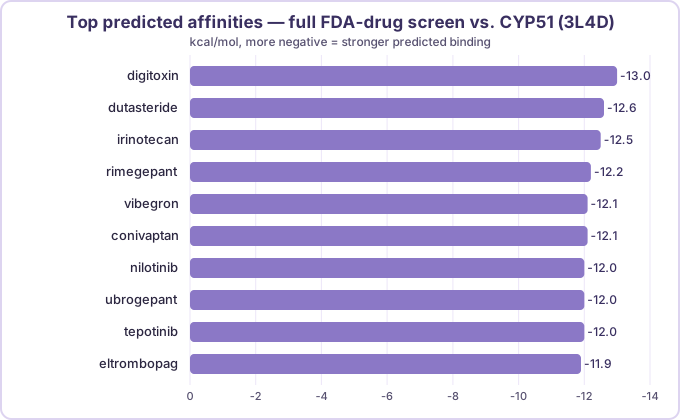
Same 1,840-drug library, 1,795 of 1,808 attempted drugs docked successfully.
Step 5: The azole question — this is the important part
Here's the real result, and it's a nuanced one rather than a clean pass/fail: no azole broke into the top 10. The best of them, itraconazole, ranked 42nd of 1,795 (−11.1 kcal/mol) — comfortably in the top 2.5% of the whole library, a genuinely strong positive signal, just not a #1 crown. The rest of the azole class clustered together right behind it in a coherent block: posaconazole (−10.5), terconazole (−10.4), ketoconazole (−10.0), oxiconazole (−9.5), sertaconazole/voriconazole (−9.4), down through miconazole (−8.5) and fluconazole (−8.2).
The one result worth being completely upfront about: fluconazole itself — the exact drug crystallized in this receptor structure, the one whose bound position literally defined the docking box — ranked only 854th of 1,795, roughly median. That's not a mistake in the receptor prep. It's a known, documented limitation of Vina's scoring function: the score correlates a fair amount with ligand size (more atoms generally means more possible favorable contacts), and fluconazole is one of the smallest, most polar molecules in the whole azole class — exactly the profile Vina's function tends to underscore, independent of whether the real binding mode is correct. It's also, not coincidentally, the cheapest azole (~$4–20/month) — so the one drug this project would most want to rank well is the one the scoring function is least kind to. Worth remembering for reading any future screen's raw top-10 list: it has a real, systematic bias toward bigger molecules that has nothing to do with how good a real inhibitor they are.
Bottom line on the sanity check: a real, class-coherent signal for azoles as a group, with itraconazole specifically landing convincingly in the strong-hit range — but not the clean "the cheap known drug reaches the very top" result that would have been the ideal outcome. Partial validation, with a real and useful lesson about the tool's limits attached.
On the actual top 10: several repeat "sticky binder" names show up again — conivaptan (a third appearance, after PTR1 and TR), nilotinib and rimegepant (second appearances, from TR), eltrombopag (second, from PTR1). Four of ten repeat hits across three chemically unrelated pockets is a stronger signal that these are just large, flexible, generically high-affinity molecules by Vina's scoring function, not genuinely CYP51-specific binders — the exact question the next post checks rigorously with real numbers instead of just noting it. Digitoxin and dutasteride are the two new top hits actually worth a closer look.
Step 6: Does the pose make sense?
Same quantitative approach as the TR screen — centroid distance to the box center, plus distance to the heme iron specifically this time, since that's the chemically meaningful landmark for this pocket.
| Drug | Distance to box center | Closest atom to heme Fe |
|---|---|---|
| digitoxin | 1.3 Å | 4.45 Å |
| dutasteride | 2.8 Å | 5.44 Å |
| irinotecan | 1.5 Å | 5.93 Å |
| rimegepant | 1.5 Å | 5.67 Å |
| vibegron | 2.6 Å | 3.17 Å |
| conivaptan | 2.0 Å | 3.18 Å |
| nilotinib | 2.0 Å | 4.92 Å |
| ubrogepant | 0.4 Å | 5.54 Å |
| tepotinib | 1.1 Å | 5.62 Å |
| eltrombopag | 2.7 Å | 5.76 Å |
All 10 land within 0.4–2.8 Å of the box center — even tighter clustering than either PTR1 or TR produced, which tracks with this being the most sharply defined pocket of the three (druggability 0.993). All 10 also sit within 3.2–5.9 Å of the heme iron, genuinely occupying the substrate-access channel above it rather than somewhere else in the box. None sit at the ~2.0–2.2 Å distance real azole nitrogens use to directly coordinate the iron — expected, since Vina's scoring function has no dative-bond/metal-coordination term at all, so it structurally can't reward that specific interaction. Another honest pipeline limitation specific to heme-containing targets, not a flaw in this particular run.
Step 7: Has anyone already tested these against a parasite? — the best hit of the project
Digitoxin has direct, confirmed activity against Leishmania infantum itself — the exact species this whole project targets, not a related species like PTR1's and TR's precedents turned up. Two independent lines of evidence: digitoxigenin (digitoxin's aglycone — digitoxin with its sugars removed) showed antileishmanial IC50 = 6.9 ± 1.5 µg/mL against L. infantum, with a selectivity index of 42.8 (good separation from toxicity to the host's own cells) — better than the same study's amphotericin B control (SI 6.1). Freitas CS, et al. "Digitoxigenin presents an effective and selective antileishmanial action against Leishmania infantum and is a potential therapeutic agent for visceral leishmaniasis." Parasitol Res. 2021;120(1):289–301. PMID 33191446. Separately, β-acetyl-digitoxin (a digitoxin derivative) showed activity against infected macrophages and reduced parasite load in vivo in mice. Freitas CS, et al. "In vitro and in vivo antileishmanial activity of β-acetyl-digitoxin, a cardenolide of Digitalis lanata potentially useful to treat visceral leishmaniasis." Parasite. 2021;28:36. PMID 33851916. This is a stronger, more direct hit than anything PTR1 or TR produced — those found precedent against a different species (saquinavir vs. L. major) or a different target entirely (nilotinib vs. T. cruzi), never the exact L. infantum target this project is actually built around.
Irinotecan also has a real, specific L. infantum precedent: it and its active metabolite SN-38 act as DNA topoisomerase IB poisons in L. infantum promastigotes, confirmed both in vitro and in an ex vivo infected-splenocyte model. Prada CF, et al. "Gimatecan and other camptothecin derivatives poison Leishmania DNA-topoisomerase IB leading to a strong leishmanicidal effect." Biochem Pharmacol. 2013. PMID 23466420. Same relationship as digitoxin-vs-CYP51: real, confirmed activity, but via a completely different mechanism (DNA intercalation, not sterol biosynthesis) than what this screen actually tests for. It's also a direct callback to the topoisomerase IB attack-vector candidate deprioritized back on the TR post — a real-world illustration of exactly the DNA-intercalation mechanism that made it a poor fit for this pipeline's normal docking approach, showing up here as a side effect of screening a different target entirely.
Dutasteride, vibegron, ubrogepant, and tepotinib have no published antiparasitic activity found — the expected novel-scaffold outcome. Dutasteride is the most mechanistically plausible of the four on priors alone: it's itself a steroid-pathway enzyme inhibitor, chemically closer to CYP51's actual sterol substrates than any of the others.
Step 8: Does the price make sense? — the catch
| Drug | Current approved use | Approx. US price | Key safety concerns |
|---|---|---|---|
| Digitoxin | Heart failure/arrhythmia (historically) | Not marketed in the US (FDA reports it is no longer manufactured there) or Canada; in Europe, currently only Germany, and it is in short supply — see the availability note below | Narrow therapeutic index, cardiac glycoside toxicity |
| Dutasteride (Avodart) | Benign prostatic hyperplasia | ~$8–40/month generic | Sexual dysfunction, gynecomastia — no black box, comparatively mild |
| Irinotecan (Camptosar) | Colorectal/pancreatic cancer chemo | ~$11/2 mL vial, generic available | Severe diarrhea, bone-marrow suppression — IV chemo, infusion-center administration |
| Vibegron (Gemtesa) | Overactive bladder | ~$500–700/month, no generic | Rare urinary retention; mostly mild GI/UTI-type effects |
| Ubrogepant (Ubrelvy) | Acute migraine | ~$1,100–1,450/10 tablets, no generic | Hypersensitivity reactions; capped at 8 uses/month |
| Tepotinib (Tepmetko) | MET exon 14-mutant NSCLC | ~$9,340–12,900/month | Interstitial lung disease/pneumonitis, hepatotoxicity |
The repeat hits are already priced on the TR and PTR1 posts.
Digitoxin is the awkward one here on the practicality axis, despite being both the single best docking score of the whole project (−13.0 kcal/mol) and the strongest literature precedent found so far — it isn't something that can be prescribed in the US today. Its still-marketed cousin digoxin is cheap and widely available, but digoxin wasn't the drug that scored well here or the drug tested in the antileishmanial literature, so it would need its own independent check before leaning on it as a substitute — not something this project can just assume.
Is digitoxin available anywhere else? I originally wrote it off as "withdrawn," then checked, with Claude Code helping search and Gemini double-checking the results. What I could confirm: an IARC monograph (published 2016, citing a 2013 list) says FDA reported digitoxin is no longer manufactured in the US and that licensed digitoxin products existed in Germany, Austria, Hungary and Norway. That list is out of date: the Austrian and Hungarian registrations now show as cancelled and Norway's product is listed as discontinued (this comes from those countries' own drug registers as checked by Gemini; I haven't re-checked them myself). That leaves Germany, where the only oral product left is Teva's Digitoxin AWD, and German pharmacy press reports it is in short supply until about January 2027. In Canada, the Health Canada drug database lists its only digitoxin product as cancelled in 2001. In the visceral-leishmaniasis countries I looked at, I found no evidence of a marketed digitoxin product. Brazil's ANVISA open data shows no active registration (just two old ones, both inactive), and a search of India's CDSCO regulatory portal returns nothing for digitoxin, though digoxin shows up plenty. Bangladesh's MedEx drug database lists no digitoxin products either. For Sudan, Ethiopia, Kenya, Nepal, South Sudan and Somalia I only searched the web and found nothing, so there "not found" does not mean "confirmed absent." Either way, being off the market isn't the barrier for lab testing: digitoxin is sold to researchers as a chemical (for example Cayman Chemical, labeled not for human or veterinary use). The 2025 DIGIT-HF heart-failure trial has renewed interest in digitoxin, but that is about heart failure, not leishmaniasis, and this project makes no treatment claims.
Dutasteride is the best practical candidate this screen produced: cheap generic, no black box, decades of safety data, and mechanistically the most plausible novel hit here.
What's next
Three screens are now done, against three chemically unrelated pockets on two different proteins — and several drugs (conivaptan, nilotinib, rimegepant, eltrombopag) have now shown up near the top of more than one of them. That's worth answering properly instead of just flagging anecdotally: is a repeat top-10 appearance real evidence of pocket complementarity, or is Vina's scoring function just consistently rewarding certain molecules no matter what pocket they're put in? Three screens is also the minimum needed to actually answer that question — two targets can't distinguish "consistently good" from "coincidence." That's the whole subject of the next post: Sticky vs. Specific. None of this is a therapeutic claim — confirmed activity of digitoxigenin (an aglycone/derivative) doesn't automatically transfer to digitoxin itself at approved cardiac doses, and nothing here says anything about CYP51 specifically as the mechanism for any hit.