The whole point of this project is drug repurposing — finding new uses for medicine that's already FDA approved. Everything so far (Hello Tools 1 and 2) proved the tools work on one protein and one ligand at a time. That's not enough to actually go looking for a new use of an existing drug. For that, I need to screen an entire library of approved drugs against a target and see which ones stick. Today was about building that library and the pipeline to screen it.
Step 1: Why one ligand isn't enough
Drug repurposing works by testing a target protein against a huge number of existing drugs and seeing which ones bind well. Hand-picking a few candidates and docking them one at a time (like Warfarin in Hello Tools 1) doesn't scale to that. I needed a real library of FDA-approved drugs, converted into a format AutoDock Vina-GPU can actually dock, and a way to screen the whole thing against a target in one run.
Step 2: Getting the data
I'm using DrugCentral as the source — it's open access, needs no login, and publishes an official "FDA Approved Drugs" list alongside a structures file with SMILES for each one (it's licensed CC BY-SA 4.0, so it gets a citation here). A script pulls both files and joins them into one clean table:
python3 biolab/scripts/fetch_drug_library.py
That produced 1,859 FDA-approved drugs with usable SMILES out of 2,331 total approved entries — the rest are mostly biologics, peptides, and other things that don't reduce down to a simple small-molecule structure.
Step 3: Turning SMILES into structures Vina can dock
A SMILES string is just a 1D text description of a molecule — Vina needs an actual 3D structure with hydrogens, charges, and a defined set of rotatable bonds. I used RDKit to embed a 3D conformer for each drug and optimize it (fixed random seed, so the results are reproducible), then Meeko — the official AutoDock ligand-prep tool — to write it out as a PDBQT file:
python3 biolab/scripts/prepare_ligand_library.py
This ran into a couple of real problems along the way. A handful of drugs have macrocyclic rings that Meeko normally handles by breaking them open with special "glue" atom types — but Vina-GPU's atom table doesn't know those types, so those ligands were failing outright. Fixing it meant telling Meeko to keep macrocycles rigid instead. After that fix, 1,840 of the 1,859 drugs converted cleanly into dockable PDBQT files.
Step 4: Screening the whole library at once
AutoDock Vina-GPU-2.1 has a built-in virtual screening mode — point it at a folder of ligands instead of a single file, and it docks every one of them against the receptor in a single run. I wrote a script that builds the config, runs the screen, and collects the results into a ranked list by predicted binding affinity:
python3 biolab/scripts/batch_dock.py --run-name <name> --receptor <target.pdbqt>
I also learned Vina-GPU hard-caps ligands at 130 atoms — anything bigger gets rejected. Rather than let the run crash partway through on a random oversized drug, the script now checks ligand size up front and cleanly logs anything too big to dock, instead of it just failing.
Step 5: A first test run
This is a pipeline check, not a real result — it's docked against the 3I3R structure I used for the Hello Tools demos, which isn't an actual disease target, and it only covers 30 of the 1,840 prepared drugs. The point was making sure the whole pipeline — download, convert, screen, rank — actually works end to end before trusting it with a real target.
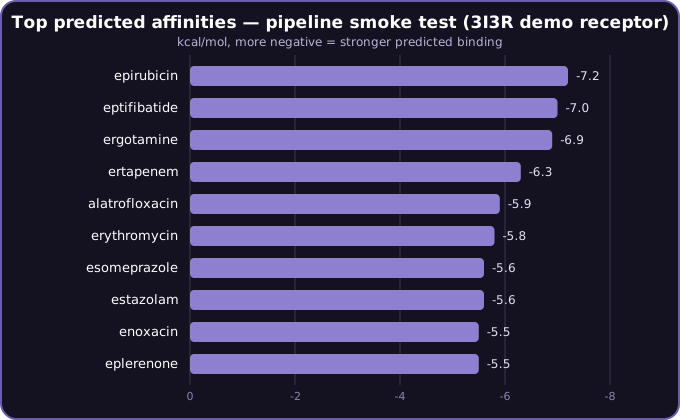
29 of the 30 test ligands docked successfully; the 30th was correctly caught and skipped by the new 130-atom check instead of crashing the run. That's exactly the outcome I wanted from a pipeline test.
What's next
The library and the screening pipeline are ready. What's still missing is the actual target — a specific disease and protein worth investigating, chosen because it's rare or doesn't get much research attention. That's the next real step, and it's a research question, not an engineering one.