National Geographic Earth Science Activity Kit
For ages 8 and up.
This toy provides five earth science themed activities: Start a rock collection, grow a crystal, dig rocks out of what appears to be plaster, baking soda and vinegar volcano, and a tornado tube.
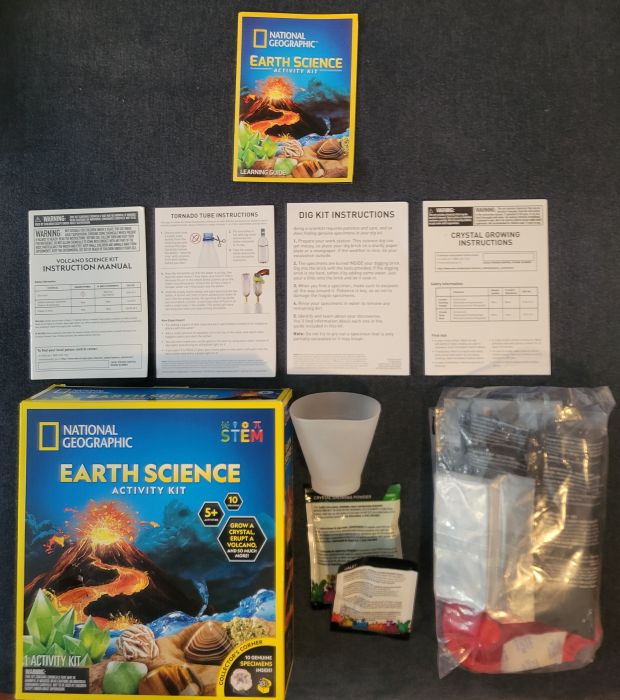
- Price: $24.99
- Fun: 5/10
- Inspiration: 3/10
- Difficulty: 3/10
- Repeatability: 2/10
- Educational Value: 3/10
Overall Verdict: I really wanted to like this one — a whole box of earth science experiments sounds like exactly my kind of toy. In practice, it's a nicely packaged, budget-friendly set that gives an 8-year-old a fun first taste of crystals and rocks, but it runs out of steam fast. Good for a single afternoon, not for someone who's going to get hooked and want to do it again next weekend.
What's Inside
- Rock Collection Kit — a small assortment of common rocks (granite, limestone, basalt, etc.)
- Crystal Growing Set — powder, seed crystals, and a silicone mold for growing a single crystal over 1–7 days
- "Excavation" Block — a plaster-like block embedded with faux rocks, meant to be "dug out" with the included tools
- Baking-Soda & Vinegar Volcano — pre-measured chemicals, a plastic volcano mold, and paint for decorating it
- Tornado Tube — a connector that links two 2-liter bottles together to make the water spin
- Learning Guide — a 16-page booklet with a brief lesson for each activity
Hands-On Experience (What Was Tested)
Crystal Growing: This was the highlight for me. The crystal started forming within the first few hours, and by 24 hours it was already a decent size — it kept growing from there and ended up looking better than I expected. Genuinely satisfying to watch.
Tornado Tube: I spun it up and got a weak little vortex for a few seconds before the water settled down. Fun for exactly one try — it's more of a fidget toy than a real demonstration of how tornadoes work.
I skipped the rock "collection" (it's really just a bag of pre-sorted stones, nothing to "collect" about it), didn't bother with the excavation block, and passed on the volcano since the baking-soda-and-vinegar reaction is a classic I'd rather save for someone seeing it for the first time.
Rating Breakdown
- Fun – 5/10: Growing the crystal is genuinely satisfying, but the rest of the kit feels more like props than real experiments. The tornado tube and excavation block get old fast.
- Inspiration – 3/10: Nothing here connects the activities to what geologists, volcanologists, or meteorologists actually do. The booklet has a few facts, but nothing that made me want to dig deeper.
- Difficulty – 3/10: Everything is well within an 8-year-old's skill range, though the crystal solution and volcano both need an adult around.
- Repeatability – 2/10: Only the tornado tube can really be reused, and even that loses its novelty after a spin or two. Regrowing a crystal means starting completely over with new powder, which defeats the point.
- Educational Value – 3/10: The booklet gives you basic vocabulary (like "gemstone" or "agate") but no real depth — no data collection, no "why does this happen," nothing to actually chew on.
Who Might Actually Like This?
- A curious 8-year-old who loves making things — this'll hold their attention for a day or two.
- Kids who love big, messy, kinetic experiments — probably not; even the volcano here is a one-shot reaction.
- Parents or teachers wanting a cheap starter kit — at $24.99, it's low-risk enough to be worth a try.
- Anyone looking for a serious STEM enrichment tool — skip this one, it doesn't go deep enough.
Pros & Cons
Pros
- Affordability: at $25, it's a cheap way to introduce a kid to earth science.
- Safety-first packaging: everything is pre-measured and non-toxic, and the instructions clearly flag where an adult should be involved.
- Compact storage: the whole thing fits in a small box you can tuck away when you're done.
Cons
- Thin content: only five activities, and three of them felt like filler I ended up skipping.
- Low replay value: once you've grown one crystal and spun the tornado tube, there's nothing new left to try.
- Minimal educational depth: the booklet reads more like a product insert than an actual learning guide.
Bottom Line
If you want a cheap way to keep an 8-year-old busy for an afternoon, this kit does the job — especially if they're into rocks or watching a crystal form. Just don't go in expecting a lasting educational experience; it's more a handful of fun party tricks than a real gateway into geology, volcanology, or atmospheric science.
Recommendation: worth buying if you're treating it as a fun one-off, not a curriculum. For a kid who's genuinely curious about earth science, I'd pair this with an actual rock-hunting trip or a crystal-growing kit built for more than one growth cycle.